

Design Intelligent Systems using LLMs, RAG, and Agentic AI
AI and Data Science: Leveraging Responsible AI, Data and Statistics for Practical Impact
 Application closes on
24th Sep 2026
Application closes on
24th Sep 2026
 Speak with our expert
+1 617 539 7216
Speak with our expert
+1 617 539 7216




Receive Your Brochure Copy
Get details on syllabus, projects, tools, and more

Top rated online AI, Data Science, and ML course
Application closes 24th Sep 2026
Why should you join this program?
-

Comprehensive AI and Data Science Curriculum
Learn from MIT-IDSS Faculty through recorded video lectures & build practical expertise in Data Science, Machine Learning, GenAI & Agentic AI through real-world case studies and hands-on projects.
-
MIT IDSS is a Global Leader in AI & Data Science
MIT is ranked #1 in the world, #1 in AI and Data Science, and #2 among U.S. national universities, reflecting its global leadership in research, innovation, and technology education. (2026 Rankings)


Program Outcomes
What will you learn to build and apply?
Build proficiency in advanced topics like Agentic AI, LLM Orchestration, and RAG.
-
Explain how AI evolved from prediction models to language models and autonomous agents
-
Write effective prompts, detect hallucinations, and use AI coding assistants to write and debug Python
-
Given a business question, choose the right ML approach, apply it, and assess if results are trustworthy
-
Connect LLMs to external data using RAG to ground outputs in real data and assess pipeline performance
-
Build AI systems that plan a sequence of steps, use external tools, and complete tasks autonomously
-
Design pipelines where multiple AI agents collaborate, divide work, recover from errors, and boost performance
Earn a certificate of completion from MIT IDSS
-
#1 in World Universities
QS World University Rankings, 2026
-
#1 in Data Science and Artificial Intelligence
QS World University Rankings by Subject, 2026
-
#2 in National Universities
U.S. News & World Report Rankings, 2026


Key program highlights
Why choose the AI and Data Science program?
-
Learn from MIT faculty
Learn from MIT faculty with expertise across AI, Data Science, Machine Learning, and Agentic AI through recorded lectures.
-
Attend Mentorship Sessions by Industry Experts
Learn from experienced industry practitioners who help connect concepts, tools, and frameworks to real-world business applications.
-
Build End-to-End AI Expertise
Progress from Data Science and Machine Learning to GenAI, RAG, AI Agents, and Multi-Agent Systems through a structured, application-focused curriculum.
-
Personalized Learning Support
Receive guidance from a dedicated program support team at Great Learning that will guide you throughout your learning journey and help you stay on track toward program completion.
-
Build Real-World AI Expertise
Strengthen practical skills through 4 hands-on projects and 10+ case studies that reflect real business challenges.
-
Earn a Recognized MIT IDSS Credential
Earn a Certificate of Completion and 8.0 CEUs from MIT IDSS that validate your AI and Data Science expertise.


Skills you will learn
Agentic AI
Prompt Engineering
Retrieval-Augmented Generation (RAG)
Multi-Agent Systems
LLM Orchestration
Prompt Optimization
AI-Assisted Coding
LLM Evaluation
AI Workflow Design
Generative AI Applications
Agentic AI
Prompt Engineering
Retrieval-Augmented Generation (RAG)
Multi-Agent Systems
LLM Orchestration
Prompt Optimization
AI-Assisted Coding
LLM Evaluation
AI Workflow Design
Generative AI Applications
view more
- Overview
- Learning Journey
- Curriculum
- Projects
- Tools
- Certificate
- Faculty
- Mentors
- Reviews
- Fees
- FAQ
Who is the program for?
Professionals ready to advance their skills in AI, Data Science, and Machine Learning
View Batch Profile
-
Career Starters in AI and Data Science
Individuals seeking a structured foundation in AI and Data Science to build job-ready technical capabilities and a strong professional credential.
-
Early-Career Professionals in Data and Technology
With a foundation in data science or software development, seeking to deepen technical expertise and design end-to-end AI workflows.
-
Tech Innovators and AI Practitioners
Responsible for building, integrating, or scaling AI solutions, seeking expertise in system design, multi-agent orchestration, and implementation.
-
Professionals Building Next-Generation AI Systems
Aiming to use advanced frameworks like GenAI, LangChain, and multi-agent systems to build reliable, scalable, real-world AI applications.
How's the learning experience of the program?
Build strategic judgement and human intuition with our unique structured learning approach.
-
Learn from Experts
Learn from MIT faculty and industry experts to master AI strategy and implementation
-
Learn By Doing
Work on business problems using the latest tools & build an e-portfolio of AI projects
-
Earn a University Credential
Earn a certificate of completion and 8 Continuing Education Units (CEUs) from MIT-IDSS
-
Get Support Throughout the Learning Journey
Program managers will help you stay on track, navigate key milestones & complete the program




What will you learn in the program?
Designed by MIT faculty, the curriculum covers key concepts in Generative AI, Agentic AI, Data Science, and Machine Learning. Learn from experts through a structured, hands-on learning experience that builds the technical intuition and strategic judgment needed to translate data and AI into measurable business impact.
Pre-Work
Concepts Covered
Week 1: AI, GenAI, and Agentic AI Landscape
Concepts Covered
Week 2: LLMs and Prompt Engineering
Concepts Covered
Week 3: AI-Assisted Python Coding
Concepts Covered
Week 4: AI-Assisted Exploratory Analysis
Concepts Covered
Week 5: Project 1
Work on a real-world challenge by applying skills learned throughout the program, leveraging industry-relevant tools and technologies to maximize outcomes.
Week 6: Predictive Modeling With Regression
Concepts Covered
Week 7: Building Decision Systems With AI
Concepts Covered
Week 8: AI-Powered Recommendation Systems
Concepts Covered
Week 9: Project 2
Work on a real-world challenge by applying skills learned throughout the program, leveraging industry-relevant tools and technologies to maximize outcomes.
Week 10: Learning Break
Learning breaks are structured pauses to consolidate concepts, complete pending work, and reinforce understanding before progressing further.
Week 11: Building Context-Aware AI Workflows
Concepts Covered
Week 12: Prompt Optimization and Evaluation
Concepts Covered
Week 13: Project 3
Work on a real-world challenge by applying skills learned throughout the program, leveraging industry-relevant tools and technologies to maximize outcomes.
Week 14: Designing and Building Agentic AI Workflows
Concepts Covered
Week 15: Orchestrating Multi-Agent Systems
Concepts Covered
Week 16: Project 4
Work on a real-world challenge by applying skills learned throughout the program, leveraging industry-relevant tools and technologies to maximize outcomes.
Self-Paced Modules
Self-Paced Modules
This module is designed to build practical capability in applying Generative AI and Agentic AI using the Claude ecosystem in real-world contexts. Learners build the ability to design, execute, and evaluate AI-driven workflows for real-world applications, supported by ~5 hours of structured learning.
Build a foundational understanding of deep learning concepts and neural network architectures used in modern AI systems.
Learn how AI systems process and interpret visual information using advanced computer vision techniques.
Explore the principles of building fair, transparent, and responsible AI systems across real-world applications.
Understand the fundamentals of time-series data analysis and forecasting for temporal decision-making.
Sample Case Studies
Apply your learning through real-world case studies guided by global industry experts. Please note: All case studies and projects outlined are indicative and subject to change.
Supply Chain Disruption Response Assistant
Clinical Trial Protocol Feasibility Review
AI-Assisted Data Cleaning for Retail Sales
Customer Segmentation for a Retail Bank
Quick-Commerce Order Volume Drivers
Loan Application Risk Triage
E-Commerce Next-Best-Product Recommendations
Employee HR Policy Assistant
Banking Customer Service Copilot
Autonomous SaaS Support Triage Agent
Competitive Market Intelligence Platform
Note: The curriculum listed above are indicative and subject to updates as technology evolves.
What case studies & projects will you solve?
Work on real-world case studies and projects using the latest tools and technologies.
-
AI-Assisted
Coding
-
10+
case studies
-
Advanced AI
Modules and Concepts

RETAIL
Customer Personality Segmentation
Description
Analyze customer purchase and demographic data to identify distinct behavioral segments that enable personalized loyalty programs and targeted promotions.
Skills you will learn
- EDA
- K-Means
- Gaussian Mixture Models
- PCA
- Clustering
- Dimensionality Reduction
- Feature Engineering
- Customer Analytics

MEDIA
OTT Platform Content Recommendation Engine
Description
Build a recommendation engine using viewing behavior and content metadata to improve discovery, increase watch time, and reduce churn.
Skills you will learn
- Rank-Based Recommendations
- Content-Based Filtering
- Collaborative Filtering
- Recommender Systems
- User Behavior Analysis
- Ranking Models
- Personalization Algorithms

LEGAL
RAG-Based Legal Contract Review Assistant
Description
Build a contract review assistant that retrieves and analyzes clauses from internal contract repositories to support faster, more consistent legal review.
Skills you will learn
- Retrieval-Augmented Generation (RAG)
- Chunking
- Embeddings
- Vector Databases
- Document Analysis
- Information Retrieval
- LLM Grounding
FINANCE
Multi-Agent Financial Research Assistant
Description
Build a multi-agent system that gathers, analyzes, and synthesizes financial data from filings, internal research, and external sources into structured sector briefings.
Skills you will learn
- Multi-Agent Systems
- Adaptive RAG
- Web Search
- Sentiment Analysis
- Information Retrieval
- Orchestration
- Tool Use
- Evaluation Metrics
- Handoff Reliability
Note: The projects listed above are indicative and subject to updates to the curriculum.
Which AI & ML tools will you learn and apply?
Learn tools like Python, GPT-5, Claude, LangChain, Codex & more to build & deploy intelligent AI systems.
-
Python
-
Google Colab
-
VS Code (Visual Studio Code)
-
OpenAI
-
Gemini
-
Claude
-
LangChain
-
LangGraph









Note: The tools listed above are indicative and subject to updates as technology evolves.
Earn a certificate of completion from MIT IDSS
Stand out in a competitive market with a certificate of completion in AI & Data Science from MIT IDSS that formally recognizes the expertise developed through rigorous, practical assessments
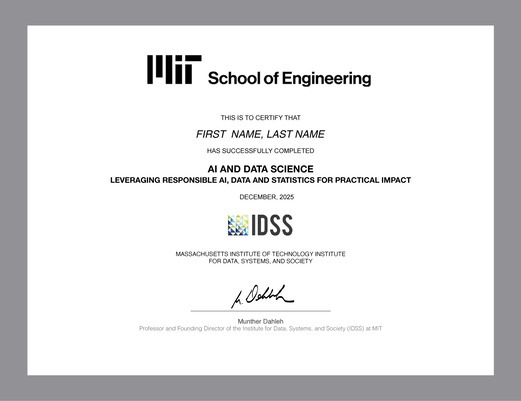
* Image for illustration only. Certificate subject to change.
Who are the faculty for the program?
Learn from renowned MIT faculty and build technical intuition to make credible, strategic decisions.
-
Munther Dahleh
William A. Coolidge Professor, EECS and IDSS; Founding Director, IDSS
Trailblazer in robust control and computational design.
Director propelling interdisciplinary research and innovation.
Know More -
Stefanie Jegelka
Associate Professor, EECS and IDSS
Expert in algorithms and optimization for AI.
Pioneer advancing theoretical machine learning foundations.
Know More -
Devavrat Shah
Andrew (1956) and Erna Viterbi Professor, EECS and IDSS
Renowned expert in large-scale network inference.
Award-winning innovator in data-driven decisions.
Know More -
John N. Tsitsiklis
Clarence J. Lebel Professor, Dept. of Electrical Engineering & Computer Science (EECS) at MIT
Leader in optimization, control, and learning.
Renowned scholar with multiple prestigious accolades.
Know More -
Caroline Uhler
Professor, EECS and IDSS
Expert in computational biology, statistics, and systems.
Award-winning scholar relentlessly driving transformative data insights.
Know More


 LinkedIn Profile
 University Link
Who are the mentors for weekly live sessions?
Learn from seasoned industry mentors to apply concepts and build practical skills.
-
Cristiano Santos De Aguiar
Data Scientist, Bresotec Medical
-
Peyman Hessari
Senior Data Scientist, ATB Financial
-
Jatin Dawar
Senior Machine Learning Engineer, Telus
-
Olabode James
Machine Learning Architect, Rubik Technologies






Note: The mentors listed above are indicative and subject to change based on availability and scheduling.
What are the reviews for the program?
Learners share their feedback on the faculty, mentors, hands-on projects, and overall learning experience.
-
Accelerate your ability to operate confidently
I would tell any aspiring learner that the MIT IDSS program is an excellent choice if they want to combine strategic thinking with modern AI and data-driven capabilities. The curriculum is rigorous but highly practical, and it gives you the tools to understand how intelligent systems shape real business decisions. If you're motivated, curious, and ready to challenge yourself, this program will accelerate your ability to operate confidently in technology-driven environments.
Read More
Joanna I Jachimczyk
Middle Management, TD Bank
Aug 2026
-
I learned a lot and loved the program flexibility.
I am a Senior Software Engineer on the AI Voice Assist Omni Channel team and recently completed the Data Science and Machine Learning: Making Data Driven Decisions program with MIT. Before I started, my background was entirely in software engineering and Generative AI, with no background in data and Machine Learning. I decided to learn new skills to better understand data and make educated, data-driven decisions, as I am working toward becoming an AI engineering manager. My learning experience was very good. I learned a lot and loved the program flexibility. My key learning outcome was being able to create my own classification models. I can now go after more AI and Data roles.
Read More
Sydnee Sampson-Blackwell
Call Rail, Atlanta
Mar 2026
-
The program empowered me to confidently build and apply machine learning models in real-world scenarios.
With a background in Industrial Engineering and over two years of experience in manufacturing and finance, I recognized the need to elevate my technical toolkit. I was motivated to dive deep into building Machine Learning models and bring data-driven innovation to my organization. The program proved to be a game-changer, advancing my understanding of models and enabling me to confidently select and deploy algorithms. I now apply tools like Python and Machine Learning to projects impacting organizational strategy. Balancing coursework with a full-time role was challenging, but meticulous planning made it worthwhile. The program significantly boosted my professional confidence, equipping me to approach complex data challenges strategically. I now transform raw data into valuable insights, building a strong foundation for future growth.
Read More
Maximiliano Salinas De Leon
Financial & Data Analyst, Reacciones Químicas
Feb 2026
-
The program helped me strengthen my understanding of core data science concepts and techniques.
I am a biotechnology engineer with a strong interest in product development, innovation, and business strategy. I have worked on projects related to food science, functional ingredients, and applied research, and I am currently developing multiple entrepreneurial initiatives in the health, wellness, and food industry. I am also completing my Master’s thesis focused on the gut microbiota–brain axis and the impact of psychobiotics on anxiety and depression. I decided to join this Data Science and Machine Learning program to strengthen my analytical and technical skills, learn how to work with real-world data, and apply machine learning to both healthcare and business decision-making. My educational background is in biotechnology engineering, with additional training in economics and product development. Before joining the program, I had experience working on research-driven and innovation-oriented projects, particularly in food science and health-related topics. Professionally, I was involved in projects that required a combination of scientific knowledge, operational planning, and business thinking, including product formulation, process optimization, and strategic development in the food and wellness sector. However, I wanted to transition into a more data-driven approach, improve my ability to analyze complex datasets, and build predictive and segmentation models that can support decision-making in real business and healthcare environments. That is why I decided to take this program. My learning experience in the program was very disappointing due to serious issues with communication and time zone management. I formally reported my relocation and updated time zone, but the schedule was not adjusted accordingly. As a result, live classes were taking place between 1:20 AM and 4:30 AM in my local time, making it practically impossible to attend consistently. Additionally, despite raising this concern multiple times, the issue was not resolved and I even received calls around 3:00 AM, which I consider highly unprofessional and disrespectful. Overall, this negatively affected my experience and my ability to benefit from the program. The program helped me strengthen my understanding of core data science concepts, including data preprocessing, exploratory data analysis, and introductory machine learning techniques. I also gained exposure to practical applications such as model evaluation and business-driven problem solving. However, due to the scheduling and support issues, my learning experience was significantly limited compared to what I expected. The program had limited positive impact on my career, mainly because the lack of flexibility and support regarding time zone changes prevented me from fully participating in the live sessions. While I gained some technical foundations, the overall experience did not meet professional standards in terms of student support and communication, and I would not recommend this program to other professionals, especially those living in different time zones.
Read More
Montserrat Aguilar Alvarez
Clinica Biloba, Madrid
Feb 2026
-
The program strengthened my ability to apply rigorous, data-driven thinking to business decisions.
I have over a decade of experience in data, analytics, and business intelligence, working in senior leadership. I wanted a more rigorous, academically grounded understanding of Data Science and Machine Learning, especially for data-driven business decisions. The MIT Data Science and Machine Learning: Making Data-Driven Decisions program stood out due to its strong theoretical foundation and real-world applicability. It deepened my understanding of statistical thinking, classification techniques, and Machine Learning fundamentals, using Python-based projects and business case studies. I applied these concepts to improve analytical rigor in revenue optimization and customer behavior analysis. Balancing the program with a full-time executive role was challenging, but the structured curriculum and clear explanations helped me stay disciplined. The program strengthened my confidence in advanced analytics discussions. I now approach problems with a methodical, hypothesis-driven mindset, considering data quality and ethical implications. This program has elevated how I frame business problems and communicate insights.
Read More
Asiedu Ansu
Head of Data and Analytics Centre of Excellence, Vodafone Ghana
Feb 2026
-
Only a well-structured program can genuinely facilitate successful learning in any subject.
I recently completed a Data Science and Machine Learning program with Great Learning, and it was an amazing experience! Although there are many 'free' or 'inexpensive' programs available online today, I found that only a well-structured program like this one can genuinely facilitate successful learning in any subject. From the beginning, the program stood out due to its comprehensive design aimed at ensuring success. It wasn't just about providing access to instructional videos; the program was crafted to support learners every step of the way. One of the most invaluable aspects was the mentoring sessions. These sessions provided a platform to discuss issues and resolve any doubts, which is essential no matter how good the videos are. Additionally, the program offered robust support whenever I encountered difficulties. In my case, having a dedicated Program Manager made a great difference. The combination of detailed instructional content, regular mentoring, and exceptional support ensured that I learned and truly understood and could apply the concepts of Data Science and Machine Learning.
Read More
Salvador Ruz
Founder, tecnifinkar (an startup)
Apr 2024
-
El curso sobrepasó mi expectativa, altamente recomendado.
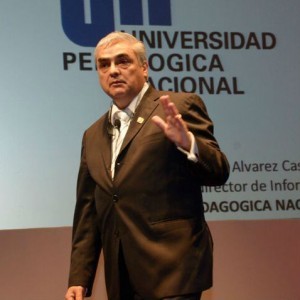
Soy el CIO de la Universidad Pedagógica Nacional. En la Universidad Pedagógica Nacional tengo el deseo de apoyar las investigaciones de las áreas de posgrado en materia de Ciencia de Datos, además con esto realizar colaboraciones interinstitucionales a nivel internacional sobre el tema. Me pareció un curso excelente, sobrepasó mi expectativa, altamente recomendado. Si bien es cierto la exigencia de repente rebasó las cargas de trabajo, al final fue muy satisfactorio el aprendizaje, los contenidos muy pertinentes, el nivel de profundidad adecuado y el material es muy bueno, sobre todo que podremos seguir accediendo a él durante un tiempo, lo cual da oportunidad de profundizar en algunos temas y recordar algunos otros. Los aprendizajes clave, fueron el retomar los conceptos aprendidos de probabilidad y estadística, aprendiendo también nuevos conceptos y su aplicación. Y sobre todo revisar el potencial de Python, que en mi caso, en programación, aunque había tenido experiencia, lo había dejado desde hace muchos años por dedicarme solo a la gestión de TI.
Read More
Victor Alvarez
subdirector, universidad pedagógica nacional
Sep 2023
-
La adopción de Ciencia de Datos es un requerimiento inmediato en mi institución.
Mi interés por la Ciencia de Datos es porque en las instituciones donde colaboro la adopción de estas tecnologías es ya un requerimiento inmediato, tanto en la parte jurisdiccional como en la parte estadística. Mi experiencia la considero muy positiva, considero diseñar un proyecto para llevar lo aprendido en la institución donde trabajo y para proyectos personales. Aprendí Python y sus principales librerías, la interpretación de los resultados.
Read More
Otilio Hernandez
titular de la unidad de servicios informaticos (cio), tribunal electoral de la ciudad de méxico
Sep 2023
-
El contenido bien estructurado y material de alta calidad transformaron mi capacidad en la Supply Chain.
Mi principal motivación fue fortalecer mi capacidad de toma de decisiones basadas en datos y combinar técnicas avanzadas de análisis con mi experiencia en Supply Chain. Buscaba herramientas y habilidades que me permitieran generar soluciones innovadoras y eficientes en el mundo de la gestión de la cadena de suministro. El contenido estaba bien estructurado, y el material de aprendizaje fue de alta calidad. Los casos de estudio presentados por la facultad del MIT eran relevantes y actuales. Los proyectos me permitieron aplicar el conocimiento teórico en escenarios prácticos. Además, el apoyo de la oficina del programa fue esencial para mi proceso de aprendizaje. Lo más interesante fue cómo la ciencia de datos y el aprendizaje automático pueden transformar y optimizar los sistemas de cadena de suministro, llevándolos a un nuevo nivel de eficiencia y precisión. Las habilidades clave que adquirí incluyen técnicas avanzadas de análisis de datos, modelado predictivo y toma de decisiones basadas en datos. Aprendí cómo aplicar estos métodos en escenarios reales, lo que ha ampliado significativamente mi capacidad de aportar valor en roles relacionados con la cadena de suministro. Recomendaría que se sumerjan completamente en el programa, aprovechando todos los recursos y oportunidades de aprendizaje que ofrece.
Read More
Eugenio Araya
subdirector de gestión y desarrollo, pontificia universidad católica de chile
Sep 2023
-
Challenging hands-on projects were worthwhile and transformed my expectations for data teams.
I am 55 years old and decided to tackle this detailed program in Machine Learning and Data Analysis, given the promise of hands-on experience. The program structure and content are highly relevant and have certainly changed what I expect from my data teams going forward. Remote learning through the Olympus platform worked very well. The content was excellent, with all lectures transcribed for future reference. The hands-on projects were challenging but worthwhile. The mentor learning sessions on weekends were detailed and an essential part of the program. I found the program support to be excellent, and it was reassuring to have someone just a WhatsApp message away for help. I have already recommended this program to others.
Read More
Kobus Burger
head of data&analytics for client solutions, standard bank group
Jul 2023









Watch inspiring success stories
Get authentic feedback from our learners sharing their experiences and insights with the program.
-
Watch story
"The people behind the program were amazing, I believe this was best part of the program"
The favourite part was the hackathon competition, where we had to combine everything that we had learnt and build the model
Arlindo Almada
,
-
Watch story
" Mentors help you understand difficult concepts and complete the course"
Studying this course has placed me in a better position to offer good counseling in my field. I am going to stretch myself to work as a Data Scientist in the business industry. I see this opportunity as a dream come true.
Berthy Buah
STMIE Coordinator , Ghana Education Service
-
Watch story
"Building Confidence in Big Data Management Without Prior Experience"
Joined the program to learn handling big data and exceeded expectations. Gained valuable skills in Python and Machine Learning. Highly recommend it for anyone starting their data analytics journey!
Chun Wing Ip
Student , University Of Sydney
What are the fees for the program?
The program fee is USD 2,500
Invest in your career
-
16-Week Online Comprehensive Journey: Build end to end AI & Data Science expertise
-
Structured Learning: Dedicate 8–12 hours weekly to faculty videos, mentor sessions, and hands-on projects
-
Dedicated Mentorship: Build practical skills in weekly live online sessions with top Industry Mentors
-
Earn a globally recognized MIT-IDSS certificate and 8 CEUs to validate your AI expertise


Application Process
The program follows a simple 3-step application process. The step-by-step process is outlined below.
-
1. Fill application form
Apply by filling a simple online application form.
-
2. Application Screening
A panel from Great Learning will review your application to determine your fit for the program your fit for the program.
-
3. Join program
After a final review, you will receive an offer for a seat in the upcoming cohort of the program.


Batch start date
-
Online · 10th Oct 2026
Admission closing soon
Frequently asked questions
What is the AI and Data Science: Leveraging Responsible AI, Data and Statistics for Practical Impact program?
The AI and Data Science: Leveraging Responsible AI, Data and Statistics for Practical Impact program is a 16-week online program offered by the MIT Institute for Data, Systems, and Society (IDSS). The curriculum is designed by MIT faculty and covers Data Science, machine learning, Generative AI, Agentic AI, and responsible AI deployment. Delivered in collaboration with Great Learning, the program combines recorded MIT faculty lectures with live mentorship sessions and four hands-on projects.
What does the MIT IDSS AI and Data Science course offer?
The 16-week online AI and Data Science: Leveraging Responsible AI, Data and Statistics for Practical Impact is offered by the MIT Institute for Data, Systems, and Society (IDSS). It offers:
● A Certificate of Completion from MIT IDSS
● 22+ hours of recorded video lectures from MIT faculty
● 14+ live mentored learning sessions
● 11 graded quizzes, 10+ case studies, and 4 hands-on projects
● Coverage of advanced topics, including Generative AI, Responsible AI, Deep Learning, and more
● A comprehensive curriculum covering both foundational and advanced concepts, including the practical application of data analytics in Artificial Intelligence
How is this program different from other data science courses?
MIT IDSS’ AI and Data Science program is different from other data science courses because of its academic rigor and industry relevance. Here are the reasons why this program stands out:
● Learn from MIT Faculty: Access recorded lectures from MIT faculty and instructors who bring academic depth and industry relevance to every session.
● Benefit From Mentorship by Industry Experts: Receive direct mentorship from professionals working in the world’s leading organizations as they share real-world applications of Data Science and AI concepts.
● Real-World Expertise: Work on 4 hands-on projects and explore 10+ real-world case studies to strengthen your skills and demonstrate your AI and Data Science capabilities.
● Build Proficiency in Key AI Concepts: Deepen your understanding of core AI concepts, including Generative AI, Recommendation Systems, Responsible AI, and Deep Learning.
● Earn a Recognized Credential: Receive a Certificate of Completion from MIT IDSS and earn 8.0 Continuing Education Units (CEUs), validating your ability to apply AI and Data Science for impact.
● Career Support: Benefit from dedicated career support, including tailored CV and LinkedIn profile reviews designed to support your transition or advancement in the field.
● Access Hands-On Labs: Get access to OpenAI API keys and Codex for AI-assisted coding, provided by Great Learning, for faster code generation and debugging workflows.
What are the learning outcomes of the MIT IDSS AI and Data Science course?
With AI and Data Science: Leveraging Responsible AI, Data and Statistics for Practical Impact, learners will:
● Explain how AI evolved from prediction models to language models and autonomous agents, and identify where each is useful versus overhyped.
● Write effective prompts, identify hallucinations, and apply structured checks to improve the reliability of AI-generated outputs.
● Use AI coding assistants to write and debug Python faster while spotting common errors to maintain code quality.
● Choose the right machine learning approach for a given business question, apply it, and assess whether the results are trustworthy.
● Connect language models to external data using retrieval-augmented generation to ground outputs in real data and evaluate pipeline performance.
● Build AI systems that plan a sequence of steps, use external tools, and complete tasks autonomously, and identify where they fail.
● Design pipelines where multiple AI agents collaborate, divide work, and recover from errors, and use metrics to evaluate performance.
What is the duration of this MIT IDSS AI and Data Science Program?
The duration of the MIT IDSS AI and Data Science Program is 16 weeks. It includes recorded lectures from award-winning MIT faculty, 10+ case studies, and 4 hands-on projects.
Self-paced modules on topics such as deep learning, computer vision, and Claude-based AI workflows are available in addition to the core schedule.
What is the required weekly time commitment for this AI and Data Science program?
The program is designed for professionals and typically requires eight to 12 hours of your time each week. Each week includes:
● Around 2 hours of recorded MIT faculty lectures
● Live Mentored Learning Sessions
● Additional time for self-study, assignments, and project work
The format ensures you can balance learning with your professional responsibilities.
How is my performance evaluated in the MIT IDSS AI and Data Science: Leveraging Responsible AI, Data and Statistics for Practical Impact?
We measure your progress through continuous assessments designed to reinforce learning and real-world application. These include:
● 11 Quizzes and graded assignments
● Case studies and hands-on exercises
● Projects to test applied understanding
To receive the Certificate of Completion from MIT IDSS, learners must score a minimum of 60% in each course. This approach ensures you stay engaged and tracks your learning outcomes throughout the 16-week program.
Who is the faculty of AI and Data Science: Leveraging Responsible AI, Data and Statistics for Practical Impact?
The AI and Data Science: Leveraging Responsible AI, Data and Statistics for Practical Impact program delivers 22+ hours of recorded video lectures from MIT faculty with expertise across deep learning, systems engineering, optimization, causal inference, and more.
The core faculty include Prof. Munther Dahleh (founding director of MIT IDSS, research in control theory and systemic risk), Dr. Caroline Uhler (faculty member at MIT with joint appointments in Electrical Engineering and Computer Science (EECS) and the Institute for Data, Systems, and Society (IDSS)), Dr. Devavrat Shah (Andrew (1956) and Erna Viterbi Professor in the Department of Electrical Engineering and Computer Science at MIT), Prof. Stefanie Jegelka (Associate Professor in the Department of Electrical Engineering and Computer Science at MIT), and Prof. John Tsitsiklis (faculty member in the MIT Department of Electrical Engineering and Computer Science).
Learners will also have access to optional modules from supporting MIT faculty members and Great Learning faculty members. The faculty list is subject to change.
What do mentors do in the MIT IDSS AI and Data Science program?
Program mentors in the AI and Data Science Program are industry professionals from organizations including Cisco, Meta, Jio, Workday, Ipsos, Fortra, and Collinson. They lead 14+ live mentorship sessions throughout the 16 weeks, focused on applying key concepts to industry case studies and projects. Mentors are different from MIT faculty: faculty design and deliver recorded lectures, while mentors provide live, personalized guidance on practical applications. The mentor list is indicative and subject to change.
What languages and tools will I learn in this AI and Data Science course?
You will learn the most in-demand languages and tools in this AI and Data Science Program, including:
● Python
● Google Colab
● VS Code
● OpenAI GPT-5
● Codex
● LangChain
● LangGraph
● Claude
Development environments, Generative AI frameworks for building autonomous agents, and evaluation techniques such as PCA and t-SNE are all part of the curriculum. Access to OpenAI API keys and Codex is provided by Great Learning for hands-on lab work.
How is the curriculum of this AI and Data Science course unique?
The curriculum, expertly crafted by MIT faculty, is designed to equip learners with industry-relevant tools and techniques, enabling them to apply these skills in AI, Data Science, Machine Learning, and Generative AI to real-world problems. Here's what makes it unique:
● Crafted by MIT faculty for academic depth and industry relevance.
● Covers complete AI and Data Science concepts from foundational techniques to advanced Machine Learning models, deep learning, NLP, computer vision, and recommendation systems.
● Focus on Generative AI and Responsible AI to ensure you're equipped for the next wave of innovation.
● Provides hands-on experience through 4 industry-relevant projects and 10+ real-world case studies.
● Built for working professionals with a flexible format, recorded lectures, and live weekend mentorship.
What do I learn each week in this program?
The 16-week curriculum covers:
● Week 0 (Pre-Work): Data Science and AI foundations, introduction to Python and programming for AI.
● Week 1: AI landscape, key terminologies, evolution from classical ML to Generative AI and autonomous agents.
● Week 2: Large language models (LLMs), foundation models, prompt engineering techniques, and business applications.
● Week 3: AI-assisted Python coding, debugging AI-generated code, prompt design for problem-solving.
● Week 4: AI-assisted exploratory analysis, clustering (K-Means, K-Medoids, Gaussian Mixture Models), dimensionality reduction (PCA, t-SNE).
● Week 5: Project 1.
● Week 6: Predictive modeling with regression, supervised learning, model validation.
● Week 7: Building decision systems with AI, classification with decision trees, Random Forest, GenAI-based text classification.
● Week 8: AI-powered recommendation systems — rank-based, content-based, and collaborative filtering; building personalized engines with Generative AI.
● Week 9: Project 2.
● Week 10: Learning break.
● Week 11: Building context-aware AI workflows, transformer architecture, Retrieval-Augmented Generation (RAG), embeddings, and evaluating RAG pipelines.
● Week 12: Prompt optimization and evaluation, hallucination detection, LLM-as-a-Judge methodology.
● Week 13: Project 3.
● Week 14: Designing and building agentic AI workflows, reinforcement learning fundamentals, autonomous agent architecture.
● Week 15: Orchestrating multi-agent systems, dynamic work routing, adaptive RAG in multi-agent workflows.
● Week 16: Project 4.
Self-paced modules available throughout the program include Claude-based AI workflows, deep learning and neural networks, computer vision methods, ethical and responsible AI, and temporal data exploration.
Does this program cover Agentic AI?
Yes. Agentic AI is one of the three headline modules listed on the program brochure. Week 1 introduces the full AI landscape, including agentic systems. Week 14 covers designing and building agentic AI workflows, including reinforcement learning fundamentals, agent architecture (memory, planning, tool use), and building single-agent systems for business problems. Week 15 covers orchestrating multi-agent systems, including dynamic work routing, adaptive RAG, error handling, and performance evaluation. A self-paced module on Claude-based AI workflows extends this content further.
How does this program teach prompt engineering?
Prompt engineering is taught across multiple points in the program rather than as a single isolated topic. Week 2 covers prompt engineering techniques for accuracy and efficiency in the context of LLMs. Week 3 covers effective prompt design for Python problem-solving using AI coding assistants. Week 12 focuses on prompt optimization for model reliability, hallucination detection through consistency checks, and the LLM-as-a-Judge evaluation methodology. The self-paced Claude-based AI workflows module covers model selection and prompt engineering using Claude Chat.
What projects and case studies are included in this program?
The program includes four hands-on projects and 10+ real-world case studies across various industries
Sample case studies span supply chain (disruption response assistant using LLMs and AI agents), healthcare (clinical trial protocol feasibility review using advanced prompt engineering), retail (AI-assisted data cleaning using Python, customer segmentation, and recommendation systems), finance (loan application risk triage and banking customer service copilot using RAG and evaluation metrics), HR (employee HR policy assistant using RAG), and tech (autonomous SaaS support triage agent and competitive market intelligence platform using multi-agent systems). Sample projects include a retail customer segmentation model, an OTT content recommendation engine, a RAG-based legal contract review assistant, and a multi-agent financial research assistant.
What role does Great Learning play in delivering this program?
Great Learning is the education delivery partner for the AI and Data Science Program. The curriculum is developed and taught by MIT IDSS faculty; Great Learning manages program delivery, learner support, and mentorship logistics.
Specifically, Great Learning provides access to experienced industry mentors, the Program Manager assigned to each learner, live mentored learning sessions, career support, including CV and LinkedIn profile reviews, and access to OpenAI API keys and Codex for hands-on lab work. The application review panel is also operated by Great Learning.
Who is this program ideal for?
The AI and Data Science: Leveraging Responsible AI, Data and Statistics for Practical Impact is ideal for:
● Career Starters in AI and Data Science
● Early-Career Professionals in Data and Technology
● Tech Innovators and AI Practitioners
● Professionals Building Next-Generation AI Systems
Learners with high school-level mathematics and statistics will be well-prepared for this program. All learners can make the most of it with the structured support provided by Great Learning.
Is this program suitable for someone without a technical background?
Yes. If you have a high school-level understanding of mathematics and statistics, you will be well-prepared for the AI and Data Science program. You do not need prior coding experience to enroll. We cover Python foundations in the pre-work and introduce AI-assisted Python coding in week three.
The program is designed in a way so that all learners can build skills progressively with the structured support provided by Great Learning. Business managers, product managers, and data analysts without deep engineering backgrounds are among the intended audience.
Can I do this program while working full-time?
The AI and Data Science Program is structured for working professionals. Lectures are pre-recorded, so learners can watch them at any time. The weekly commitment of eight to twelve hours is spread across self-paced content, assignments, and live mentorship sessions. A dedicated Program Manager from Great Learning supports learners throughout the 16 weeks and can help with pacing.
Do I need to know how to code before joining this program?
No prior coding experience is required to enroll in the AI and Data Science Program. The program builds Python skills progressively, starting with AI-Assisted Python Coding in Week 3, which covers how AI coding assistants generate Python code, debugging, prompt design for problem-solving, and security considerations. Learners with high school-level mathematics and statistics are well-prepared to start.
What is the registration process to pursue this online MIT IDSS AI and Data Science Program?
The registration process for this AI and Data Science program is as follows:
● Step-1: Register by completing the online application form.
● Step-2: A panel from Great Learning will review your application based on your academic performance, work experience, and motivation to assess your fit for the program.
● Step-3: After a final review, you will receive an offer for a seat in the upcoming cohort of the program.
Will I receive a certificate after completing the MIT IDSS AI and Data Science course for working professionals?
Upon successful completion of AI and Data Science: Leveraging Responsible AI, Data and Statistics for Practical Impact, you will receive a Certificate of Completion from MIT IDSS and also earn 8.0 Continuing Education Units (CEUs), validating your ability to apply AI and Data Science for impact. The certificate is a formal recognition of the expertise developed throughout the program, not a degree or academic credit.
What are CEUs, and how many does this program award?
Continuing Education Units (CEUs) are a standardized measure of participation in non-degree professional development programs. One CEU represents ten contact hours of participation in an organized continuing education experience. The AI and Data Science Program awards 8.0 CEUs upon successful completion, recognizing the learner's commitment to structured, applied learning in AI and Data Science.
What support is available if I fall behind or struggle during the program?
Each learner is assigned a dedicated Program Manager from Great Learning who serves as the primary point of contact throughout the 16-week program. The Program Manager monitors learner progress, provides timely assistance, and supports learners in staying on track toward their learning objectives. The structured schedule includes a dedicated learning break at Week 10, designed to allow learners to consolidate concepts and complete pending work before advancing.
What is the program fee?
The total program fee is USD 2500.
Do I need to pay any additional charges for buying books, virtual learning material, or license fees?
No. All required learning materials are provided online through the Learning Management System (LMS). Because these fields continue to evolve, you will also receive a list of recommended books and resources for optional, in-depth exploration.
What are the available payment options for registering for the online Data Science course from MIT IDSS?
Applicants can pay the program fee through Bank Transfer and Credit/Debit Cards. They can also pay in easy installments using PayPal credit options and get interest-free payments for up to 6 months (Note that these services are subject to credit approval by PayPal). [For further details, please get in touch with us at ai-ds.mit.idss@mygreatlearning.com.
Is there any refund policy?
Please note that submitting the registration fee constitutes enrollment in the program, and the cancellation penalties outlined below will be applied. If you are unable to attend your program, please review our dropout and refund policies below:
● Dropout requests received within 7 days of enrollment and more than 42 days prior to the commencement of the program will incur no fee. Any payment received will be refunded in full.
● Dropout requests received more than 42 days prior to the program but more than 7 days after the acceptance are subject to a cancellation fee of USD 250.
● Dropout requests received 22-41 days prior to the commencement of the program are subject to a cancellation fee equal to 50% of the program fee.
● Any dropout requests received fewer than 22 days prior to the commencement of the program are subject to a cancellation fee equal to 100% of the program fee.
● No refund will be made to those who do not engage in the program or leave before completing a program for which they have registered.
Are there any corporate sponsorship programs?
We accept corporate sponsorships and can assist you with the process. [For more information, please write to us at ai-ds.mit.idss@mygreatlearning.com .
How do I become a Data Scientist?
To become a Data Scientist, you need to have a blend of technical expertise, analytical thinking, and real-world problem-solving skills. If you have a strong academic background, that will help you learn the concepts related to the field.
Here’s how you can start:
● Build a strong foundation in mathematics, statistics, and programming.
● Gain hands-on experience with tools used in the industry.
● Develop applied knowledge through projects that simulate real-world data challenges.
● Strengthen your understanding of Generative AI, AI, and Machine Learning techniques.
Is the future of Data Science and AI promising?
Yes, the future of Data Science and AI is highly promising. As organizations become more AI and data-driven, the demand for professionals who can turn raw data into strategic insights using data analytics in Artificial Intelligence is growing. Here’s why:
● Growing demand in Business: Companies are leveraging AI and Data Science to reduce costs, improve marketing effectiveness, launch better products, and tap into new markets.
● Data-driven strategy making: Gartner has forecasted that many corporate strategies will highlight data and analytics as essential business competencies.
● Expanding applications: From healthcare and finance to retail and tech, Data Science is shaping decision-making and driving innovation across industries.
● Career longevity: With data at the core of digital transformation, professionals with expertise in AI, ML, and Data Science are well-positioned for long-term career growth.
As industries increasingly rely on data to drive innovation and growth, the need for skilled Data Science professionals will only continue to rise.
Gaining expertise in Artificial Intelligence, Machine Learning, and Data Science is a smart investment for you to future-proof your career.
What are Data Science and Machine Learning, and how are they related?
Data Science is a field that uses statistical and analytical methods to extract meaningful insights from data, insights that inform decisions, uncover patterns, and drive measurable business outcomes. Machine Learning is a core set of techniques within Data Science that enables computers to learn from data and improve their performance without being explicitly programmed for every task.
In practice, Data Science defines the problem and prepares the data; Machine Learning provides the methods to build predictive models from it. Together, they form the technical foundation for most modern AI applications i.e. from recommendation engines and fraud detection to autonomous agents and large language models.
Why choose Data Science and Machine Learning?
Organizations across industries increasingly rely on advanced Data Science and Machine Learning to drive strategic decision-making and improve business outcomes. Here’s how Data Science and Machine Learning create impact.
Inform stronger business strategies: Leading companies use data-driven insights and Machine Learning models to design effective business plans, optimize operations, and accelerate growth.
Deliver solutions that meet customer needs: Organizations with clear data strategies can anticipate market trends, innovate faster, and build products that offer greater value to end users.
Reduce operational costs: For small and medium-sized enterprises, AI, Data Science, and Machine Learning enable more efficient processes and cost-effective solutions, helping them stay competitive despite limited resources.
This combination of strategic insight, customer-centric innovation, and operational efficiency is why Data Science and Machine Learning have become essential capabilities for modern businesses.
What is the average salary of an AI, Data Science, or Machine Learning Professional?
According to BuiltIn.com, the average salary for an AI professional in the United States is $184,757. As per Indeed.com, For a Data Scientist, it is $130,388, and for a Machine Learning Specialist, it is $189,067.
What are the key Data Science career opportunities across different industries?
Data science is a universal requirement in the modern economy, with specific roles including:
● Finance: Loan application risk triage and customer segmentation for retail banks.
● Healthcare: Predicting hospital length of stay (LOS) and clinical trial protocol feasibility reviews.
● Retail & E-commerce: Developing recommendation engines and identifying quick-commerce order volume drivers.
● Tech: Building autonomous SaaS support triage agents and multi-agent systems.
Are there careers in Data Science for non-technical professionals?
Yes. There is a rising demand for Product and Business Managers who can evaluate AI solutions, understand Large Language Models (LLMs), and oversee decision systems. These roles focus on the strategic judgment and human intuition required to implement AI successfully, rather than just writing code.
What are the essential tools beyond Python for a Data Science career?
To stay competitive, professionals should be proficient in:
● Development Environments: VS Code and Google Colab.
● Generative AI Frameworks: LangChain and LangGraph for building autonomous agents.
● Visualization & Analysis: Techniques such as PCA and t-SNE for making sense of unstructured data.
What is Agentic AI, and why is it relevant now?
Agentic AI refers to AI systems that do not just respond to a single prompt. They plan a sequence of steps, use external tools, execute actions, adapt based on results, and complete tasks autonomously. The distinction from conventional AI models is that agentic systems operate over multiple steps with memory, planning, and tool use built in. The AI and Data Science Program devotes two full weeks (Weeks 14 and 15) to designing agentic AI workflows and orchestrating multi-agent systems, reflecting the practical reality that most enterprise AI deployments in 2026 involve some form of autonomous or semi-autonomous agent pipeline.
What is Responsible AI, and how does this program include it?
Responsible AI refers to the practice of building AI systems that are fair, transparent, and accountable, systems whose decisions can be explained, audited, and corrected. The AI and Data Science Program includes a dedicated self-paced module on Ethical and Responsible AI, covering the AI lifecycle, bias, causality, privacy, and interdependency in AI systems.
Delivered in Collaboration with:

MIT Institute for Data, Systems, and Society (IDSS) is collaborating with online education provider Great Learning to offer AI and Data Science: Leveraging Responsible AI, Data and Statistics for Practical Impact. This program leverages MIT's leadership in innovation, science, engineering, and technical disciplines developed over years of research, teaching, and practice. Great Learning collaborates with institutions to manage enrollments (including all payment services and invoicing), technology, and participant support. Accessibility
 Application Closes
24th Sep 2026
Application Closes
24th Sep 2026

-
MIT Professional Education
Applied AI and Data Science Program
15 Weeks · Live Online · Weekdays & Weekend
-
McCombs School of Business at The University of Texas at Austin
Post Graduate Program in Data Science with Generative AI: Applications to Business
7 months · Online · Weekend
-
McCombs School of Business at The University of Texas at Austin
Data Analytics Essentials
21 weeks · Online
No Programming Experience -
McCombs School of Business at The University of Texas at Austin
Post Graduate Program in Data Science with Generative AI: Applications to Business
7 Months · Online
-
McCombs School of Business at The University of Texas at Austin
Data Analytics Essentials
22 Weeks · Online
No Programming Experience -
10 Weeks · Online
-
3 Months · Online






Similar free courses for you
-

 Beginner
 2.0 Hrs
Data Science Essentials
-

 Beginner
 2.0 Hrs
Python for Data Science
-

 Intermediate
 1.5 Hrs
Feature Engineering
-

 Intermediate
 2.5 Hrs
Data Mining
-

 Beginner
 1.0 Hrs
Statistical Analysis
-

 Beginner
 1.5 Hrs
Exploratory Data Analysis Essentials
-

 Beginner
 2.0 Hrs
Introduction to Analytics
-

 Beginner
 2.0 Hrs
Data Visualization using Tableau
-

 Beginner
 2.0 Hrs
Introduction to Power BI Analyst
-

 Intermediate
 8.0 Hrs
Tableau Data Visualization Essentials


.jpg "Introduction to Power BI Analyst")
Explore latest trends & topics
-
Top Data Scientist Skills You Have In 2026
2026-06-11 04:44:34 UTC
-
100+ Data Science Interview Questions in 2026
2026-06-11 04:43:41 UTC
-
Top 9 Job Roles in the World of Data Science
2026-06-11 04:42:33 UTC
-
Create MIS Reports in Excel
2026-06-11 04:39:47 UTC
-
13 Data Analyst Skills to Get Hired in 2026
2026-06-11 04:36:50 UTC
-
Excel Tools for Data Analysis
2026-06-11 04:32:44 UTC
-
Complete Data Science Roadmap 2026
2026-06-11 04:30:58 UTC
-
Jobs in Data Science and Business Analytics
2024-11-12 10:23:26 UTC
-
What is Data Science? - The Complete Guide
2024-01-24 07:28:57 UTC
-
How to Make the Career Transition From Data Analyst to Data Scientist?
2022-09-23 09:24:30 UTC









Batch Profile
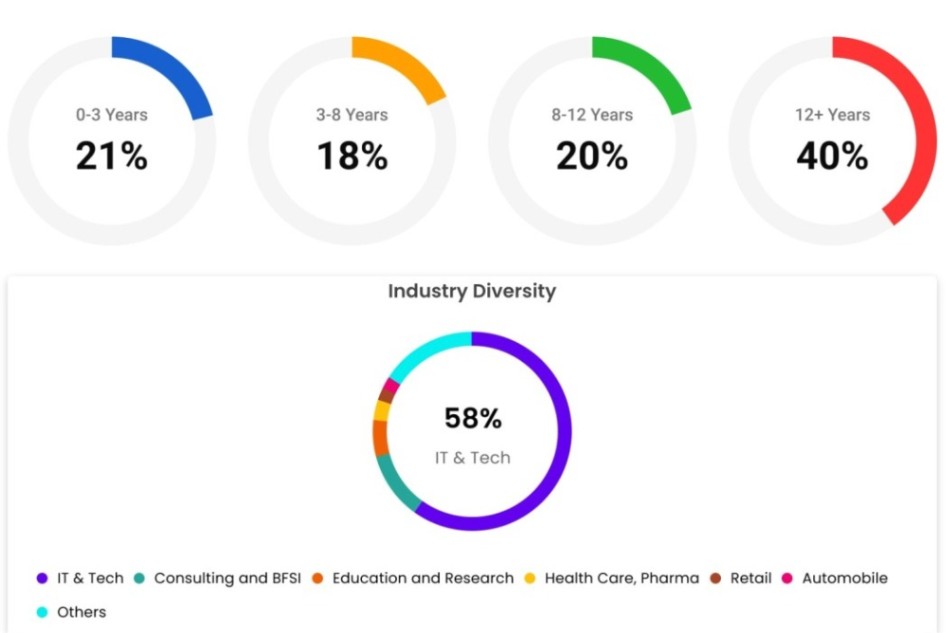
The AI and Data Science class consists of working professionals from excellent organizations and backgrounds maintaining an impressive diversity across work experience, roles and industries.
Introduction to the Data Science & Machine Learning Course from MIT for Working Professionals
Numerous professional courses are available across the globe for Data Science and Machine Learning. Yet, there are several reasons for working professionals to register in this Machine Learning and Data Science professional certificate program from MIT IDSS, collaborating with Great Learning. The reasons are drafted below:
-
MIT is an abbreviation of the Massachusetts Institute of Technology, one of the world's highest-ranked institutions.
-
According to rankings by QS World University Rankings 2023, MIT has ranked #1 university globally, and according to rankings by the U.S. News and World Report 2023, MIT is ranked #2 in the world.
-
The objective of MIT IDSS is to extend education and research in state-of-the-art analytical techniques in statistics and data science, information and decision systems, and the social sciences, and to apply these techniques to address complex societal challenges in a miscellaneous set of areas like finance, urbanization, social networks, energy systems, and health.
Benefits of Pursuing MIT Data Science Certificate Course
-
Pursue the MIT Data Science certificate course and learn these cutting-edge technologies from 11 award-winning MIT faculty and instructors.
-
These award-winning MIT faculty members have designed the curriculum to build industry-valued skills.
-
You can demonstrate your Data Science and Machine Learning Leadership by creating a portfolio of 15+ case studies and 3 real-life projects.
-
You will work in a robust collaborative environment to communicate with peers in Data Science and Machine Learning.
-
Obtain live mentorship sessions and guidance from Machine Learning and Data Science professionals on applying concepts taught by the faculties.
Alumni IDSS Benefits
Have a glance at the benefits offered by IDSS alumni:
-
Participants can obtain exclusive discounts on present and future courses offered by MIT IDSS.
-
Participants can acquire a subscription to MIT IDSS alumni mailing and newsletter lists.
-
Participants can acquire membership to advance notice of upcoming events and courses.
Details about MIT Data Science Course
In this comprehensive MIT Data Science online course, the participants will grasp all the critical skills required to master Data Science and Machine Learning. Let’s go through the extensive details about the course in Data Science for working professionals:
Course Learnings:
-
Obtain an understanding of the intricacies of Data Science tools, techniques, and their significance to real-world problems.
-
Learn the procedure to implement several Machine Learning techniques for solving complex problems and making data-driven business decisions.
-
Explore two noteworthy realms of Machine Learning, Deep Learning & Neural Networks, and learn how to apply these techniques to areas like Computer Vision.
-
Choose the process of representing your data while making predictions.
-
Obtain an understanding of the theory behind recommendation systems and analyze their applications to numerous industries and business contexts.
-
Learn the method to create an industry-ready portfolio of projects for demonstrating your ability to derive business insights from data.
Course Syllabus:
-
It commences with the fundamentals of Python programming language (NumPy, Pandas, and Data Visualization) and Statistics for Data Science.
-
Afterward, participants will learn Machine Learning techniques, including Supervised and Unsupervised Learning Techniques, Clustering, Regression, Decision Trees, Random Forests, Classification and Hypothesis Testing, and several other algorithms.
-
Moving forward, participants will learn Deep Learning, Recommendation Systems, Networking & Graphical Models, Predictive Analysis, and Feature Engineering.
[Explore MIT Data Science Course Syllabus]
Course Eligibility:
-
Working professionals, such as early-career professionals or senior managers who want to pursue a career in Data Science and Machine Learning
-
Working professionals like Data Scientists, Data Analysts, or ML Engineers interested in leading Data Science and Machine Learning initiatives at their firms or businesses
-
Entrepreneurs interested in innovation with the assistance of Data Science and Machine Learning techniques
MIT Data Science for Working Professionals Course Duration
This professional course is for 12 weeks with recorded lectures from award-winning, world-renowned MIT faculty members and live mentorship sessions from industry experts.
Secure a Data Science Professional Certificate, along with Machine Learning from MIT IDSS
After successfully pursuing this course, you will secure a professional certificate in Data Science and Machine Learning: Making Data-Driven Decisions from MIT IDSS.
Hey there! Welcome back.

Forgot your password? No problem.

You are already registered. Please login instead.
Login
Forgot Password?
Enter your registered email and we'll send you a link to change your password.