Free Python Course for Beginners
Python Fundamentals for Beginners
 4.55
Beginner level
3.75 learning hrs
4.55
Beginner level
3.75 learning hrs
Learn the fundamentals of Python programming, including variables, loops, object-oriented programming, file handling, regex, and Pytest. Enroll in this free Python course to gain hands-on practice for real-world coding.
Instructor:
Mr. Bharani Akella


What you'll learn


About this course
This free online Python programming course is designed to teach you the essentials of Python, starting with core concepts like variables, data types, operators, and loops. You’ll be introduced to Jupyter Notebook, a powerful tool for interactive coding. As the course progresses, you’ll learn object-oriented programming (OOP) principles, helping you structure and organize your code efficiently. You will also cover exception handling and file management in Python, gaining the skills to handle errors and work with external data.
The course also introduces you to advanced Python topics, including Regular Expressions (RegEx) for pattern matching and text manipulation. You’ll explore Pytest, learning how to write and run tests to ensure your code works as expected. Additionally, you’ll discover how to use GitHub Copilot for executing Python programs, streamlining your workflow. By the end of the course, you’ll have the practical knowledge needed to write, test, and debug Python code effectively, setting a solid foundation for your development career.
Course outline
Introduction to Programming: Industry Applications and Automation
Define programming paradigms and industry applications. Explore how software engineering automates tasks, processes data, and scales operations across domains like web development and data science.
Programming Variables: Memory Allocation and Data Storage
Understand memory allocation in computer science. Define variables as named storage locations in system memory used to store, retrieve, and manipulate data dynamically during program execution.
Control Flow: Conditional Decision-Making Statements
Control program execution paths using conditional statements. Implement if, else-if, and else logic to execute specific code blocks based on dynamic Boolean conditions and logical evaluations.
Iteration Structures: Looping and Code Automation
Automate repetitive tasks using Iteration Structures. Implement loops to execute code blocks continuously until a specific exit condition or counter threshold is met.
Modular Programming: Functions and Code Reusability
Write modular, reusable code using Functions. Define function signatures, pass arguments, and return values to break down complex algorithms into manageable sub-routines.
Object-Oriented Programming (OOP): Classes and Objects
Model real-world entities using Object-Oriented Programming (OOP). Define Classes as architectural blueprints and instantiate Objects with specific attributes (properties) and methods (behaviors).
Algorithm Design and Computational Problem Solving
Formulate step-by-step computational solutions using the Algorithmic Approach. Design logical sequences to process inputs, optimize mathematical operations, and generate accurate outputs for complex problems.
Python Setup: PyCharm, Anaconda, and Jupyter Installation
Configure a professional Python development environment. Install the Python interpreter, set up the PyCharm IDE, deploy Anaconda for package management, and launch Jupyter Notebooks.
Interactive Coding with the Jupyter Notebook Environment
Execute Python scripts interactively using Jupyter Notebook. Navigate the browser-based REPL (Read-Eval-Print Loop) environment for data analysis, code testing, and inline visualization.
Python Data Types: Integers, Floats, Strings, and Booleans
Declare and initialize Python variables. Manage system memory dynamically by assigning primitive data types including integers (int), floating-point numbers (float), text (str), and logical values (bool).
Python Operators: Arithmetic, Relational, and Logical
Execute programmatic calculations using Python Operators. Apply Arithmetic operators for math, Relational operators for value comparison, and Logical operators (AND, OR, NOT) for complex Boolean evaluations.
Python Lexical Structure: Tokens, Keywords, and Identifiers
Analyze the lexical components of Python syntax. Identify standard Python Tokens including reserved Keywords, user-defined Identifiers, hardcoded Literals, and functional Operators.
Strings in Python
This module begins with an introduction to Python strings. You will learn to implement Python strings in 3 different ways in the Jupyter notebook. You will also be familiarized with some inbuilt string functions of Python.
Data Structures in Python
Data structures in Python include tuple, list, dictionary, set, conditional statement, and looping statement. This section shall enrich your knowledge on each of these with the code snippets in Jupyter Notebook.
If Statement in Python
This section explains why and when to use “if-else” statements and demonstrates how to use them with an example.
Looping Statements in Python
This section explains why and when to use “loop” statements and demonstrates how to use them with an example.
Functions in Python
This section shall define what functions are in Python and demonstrate how a block of code performs a targeted action with an ATM working example.
Intro to Object Oriented Programming in Python
This section shall begin by introducing you to OOPs, then continues by demonstrating how to create classes, adding parameters into the method, and constructors. You will then learn the concept of inheritance and understand its different types later in this section.
Creating Python Classes: Blueprint Initialization
Define a Python Class as a structural blueprint. Use the 'class' keyword to encapsulate related variables (attributes) and functions (methods) into a single, cohesive software entity.
Python Class Methods and the 'self' Parameter
Define interactive class behaviors using Python Methods. Pass parameters into methods and utilize the mandatory 'self' parameter to access and modify instance-specific attributes.
Python Constructors: The initDunder Method
Initialize object state upon instantiation using Python Constructors. Define the init dunder method to automatically assign initial values to instance attributes when a new object is created.
Python Inheritance: Parent and Child Class Relationships
Promote code reusability using Python Inheritance. Create Child classes that inherit attributes and methods from a Parent (Base) class to extend application functionality efficiently without redundant coding.
Advanced Inheritance: Single, Multiple, and Multi-Level
Architect complex class hierarchies. Implement Single, Multiple, Multi-Level, and Hybrid inheritance models in Python to establish sophisticated parent-child relationship chains and Method Resolution Orders (MRO).
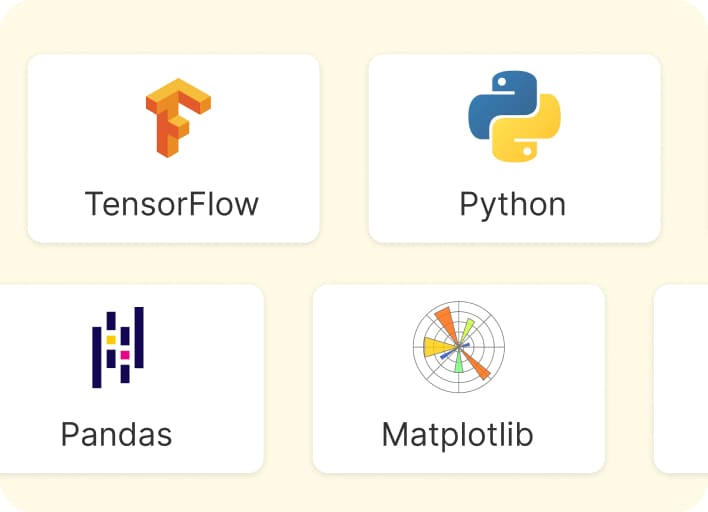
Master in-demand tools

Python

Github Copilot

Anaconda

Jupyter Notebook

PyCharm

PyTest
Get access to the complete curriculum once you enroll in the course
This course is ideal for
- Beginners with no prior coding experience
- Data science enthusiasts starting with Python
- Students aiming to build a foundation in programming
- Professionals looking to automate tasks using Python
 4.55
4.55
Level up with advanced skills & become job ready with Pro+
Subscribe to Pro+ today to build skills with 50+ Pro courses and prep for jobs with advanced AI tools.
 PRO
PRO

Practice exercises
Guided Projects
AI Resume Builder
AI mock interviews

















What our learners enjoyed the most
Skill & tools
62% of learners found all the desired skills & tools
Our course instructor

Mr. Bharani Akella
Data Scientist
IT & Software Expert


Frequently Asked Questions
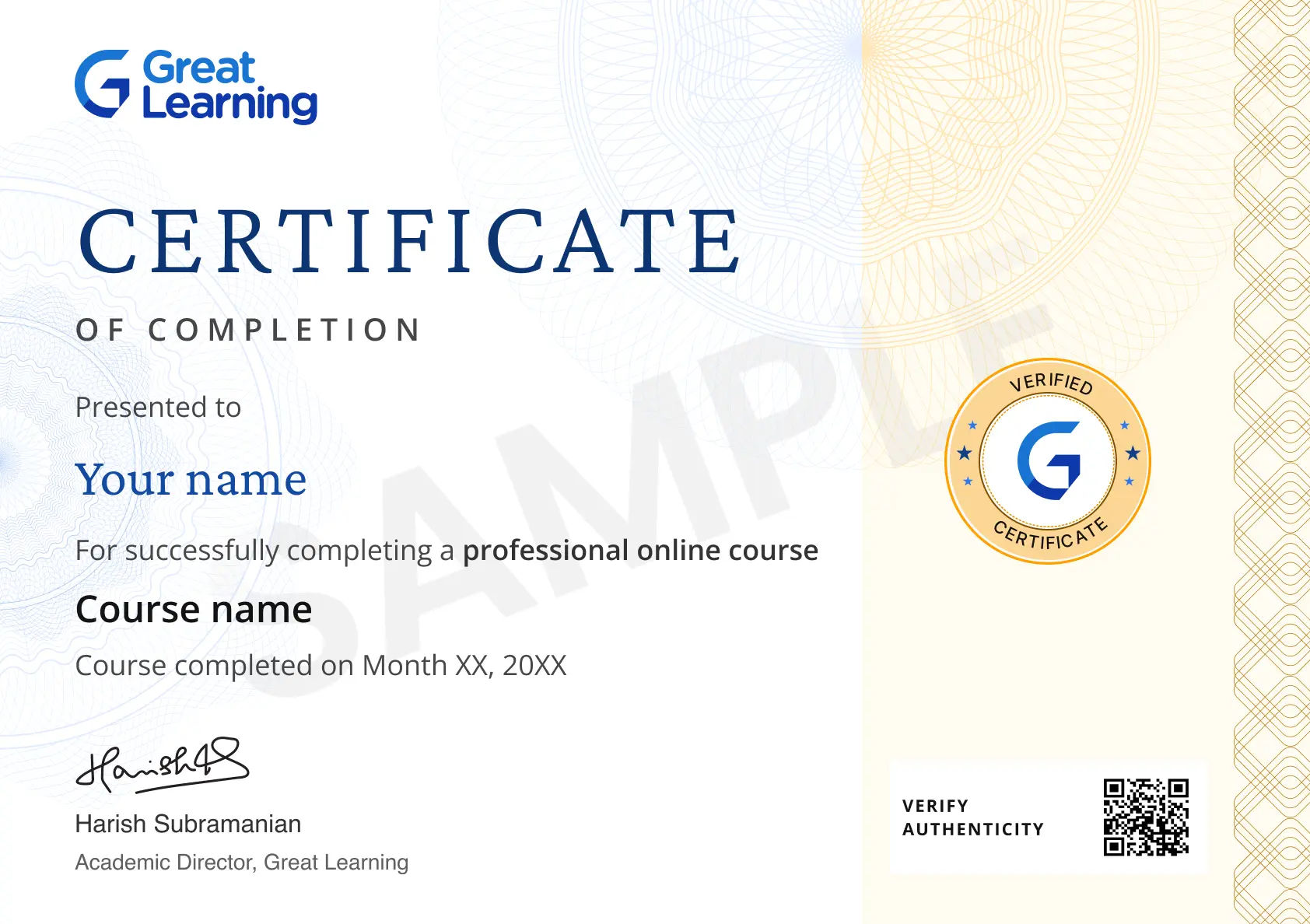
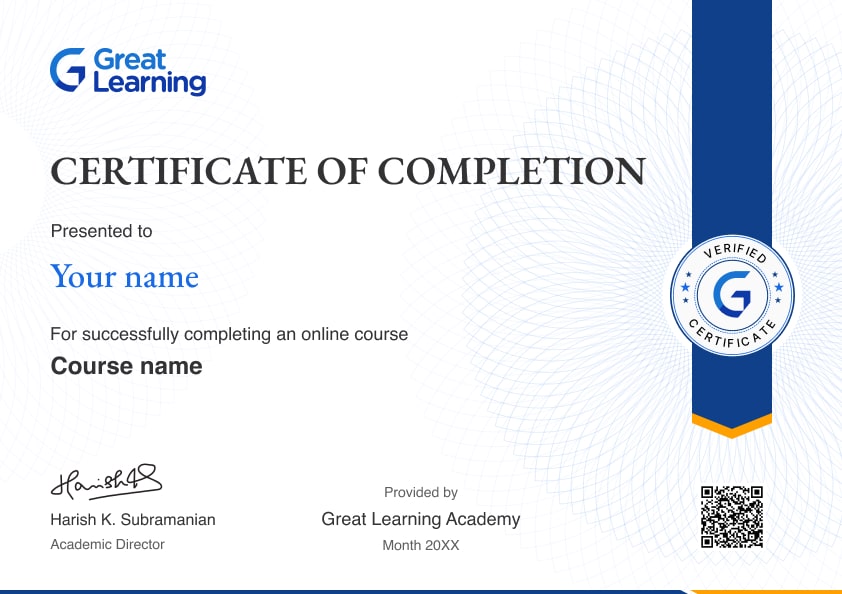
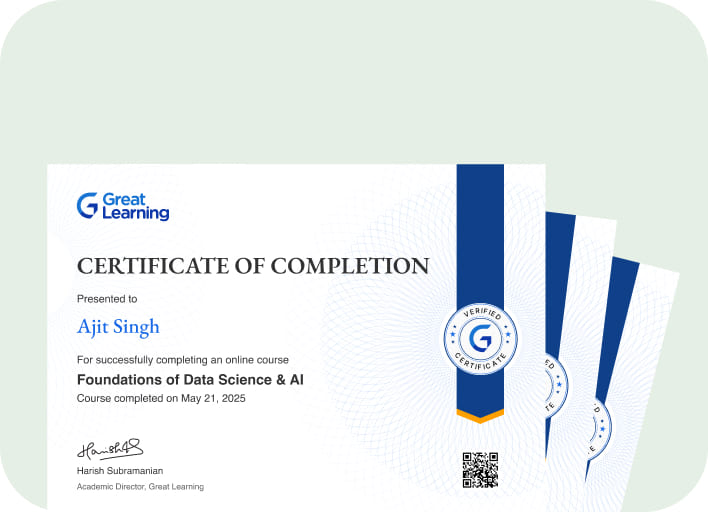
Will I receive a certificate upon completing this free course?
Is this course free?
What will I learn in this free Python course?
Is this Python course with Certificate suitable for complete beginners?
Yes. The course is designed for beginners with no prior coding experience and starts with basic programming and Python concepts.
Will I learn Python functions in this course?
Yes. You’ll learn how Python functions work, including defining functions, passing arguments, and returning values.
Will I learn object-oriented programming (OOP) in Python in this course?
Yes. The course introduces classes, objects, constructors, methods, and inheritance in Python.
Will I learn Python file handling?
Yes. The course covers file handling along with exception handling for working with files and managing errors.
Will I learn Regex in Python?
Yes. The course introduces regular expressions for pattern matching and text manipulation.
Does this Python course include pytest?
Yes. The course provides an introduction to pytest and covers writing and running Python tests.
What modules are included in this free Python course for beginners?
The course includes:
- Introduction to Programming and Python Basics
- OOPs in Python
- Exception and File Handling
- Python RegEx
- Introduction to Pytest
- Tools in Pytest
- GitHub Copilot using Python
Can beginners learn Python programming from Scratch with this course?
Yes. The course starts with Python basics and gradually introduces programming concepts, allowing beginners to build a foundation in Python programming.
Will I be able to write basic Python programs after this course?
Yes. You’ll practice core Python concepts such as variables, data structures, control flow, and functions to build basic programs
What skills will I gain after completing the free Python course?
Who should enroll in this free Python Training?
How long does this course take to complete?
How will this free course help me in real-world work?
Does this introduction to python course cover file handling and error handling?
Can I learn this free Python course Online at my own pace?
What advanced programs can I explore after this free course to apply Python to real-world data science and AI projects?
After completing this free Python course, you can apply the fundamentals you learn through projects in data analysis, machine learning, and AI. Start by working with datasets, creating visualizations, building simple models, and solving practical business problems. If you want a structured data science and AI course with deeper project-based learning, you may explore the IIT Bombay e-Postgraduate Diploma in Artificial Intelligence and Data Science or the MIT Professional Education Applied Data Science Program, based on your goals, experience, and preferred learning depth.
Recommended Free Computer courses
-
FREE

-
FREE
-
FREE
-
FREE
-
FREE
-
FREE
-
FREE
-
FREE
 FREE
FREE



.jpg "Course thumbnail image")


Related IT & Software Courses

-
McCombs School of Business at The University of Texas at Austin
Post Graduate Program in Cyber Security20 weeks · Online
Know More