Free Programming Fundamentals Course
Programming Fundamentals
 4.45
Beginner level
3.0 learning hrs
4.45
Beginner level
3.0 learning hrs
Enroll now and take the first step towards a successful career in tech with our free course on Programming Fundamentals. Start coding with confidence and gain the skills to build your own projects today!
Instructor:
Mr. Bharani Akella




About this course
In this course, you will be learning introduction to programming, and how it plays an important role in building applications. Then we will be discussing what are variables and operators. Next, we will be discussing the operators precedence as well. This course will help you crack many interview rounds related to programming fundamentals. You will gain knowledge on the foundations required to clear the programming rounds.
Explore our Software Engineering Courses today.
Course outline
Introduction to Programming: Industry Applications and Automation
Define programming paradigms and industry applications. Explore how software engineering automates tasks, processes data, and scales operations across domains like web development and data science.
Programming Variables: Memory Allocation and Data Storage
Understand memory allocation in computer science. Define variables as named storage locations in system memory used to store, retrieve, and manipulate data dynamically during program execution.
Operators in Programming
This module provides insight into various types of operators utilized in programming, including arithmetic, relational, and logical operators..
Iteration in Programming
This module gives you a comprehensive understanding of iteration in programming Iteration is the repetition of a specific process in a computer program.
Number Series
This module provides an overview of number series in programming, which are a sequence of numbers that follow a logical rule and are arranged in a mathematical pattern.
Get access to the complete curriculum once you enroll in the course
 4.45
4.45






Our course instructor

Mr. Bharani Akella
Data Scientist


Frequently Asked Questions
Will I receive a certificate upon completing this free course?
Is this course free?
Will I get a certificate after completing this Programming Fundamentals free course?
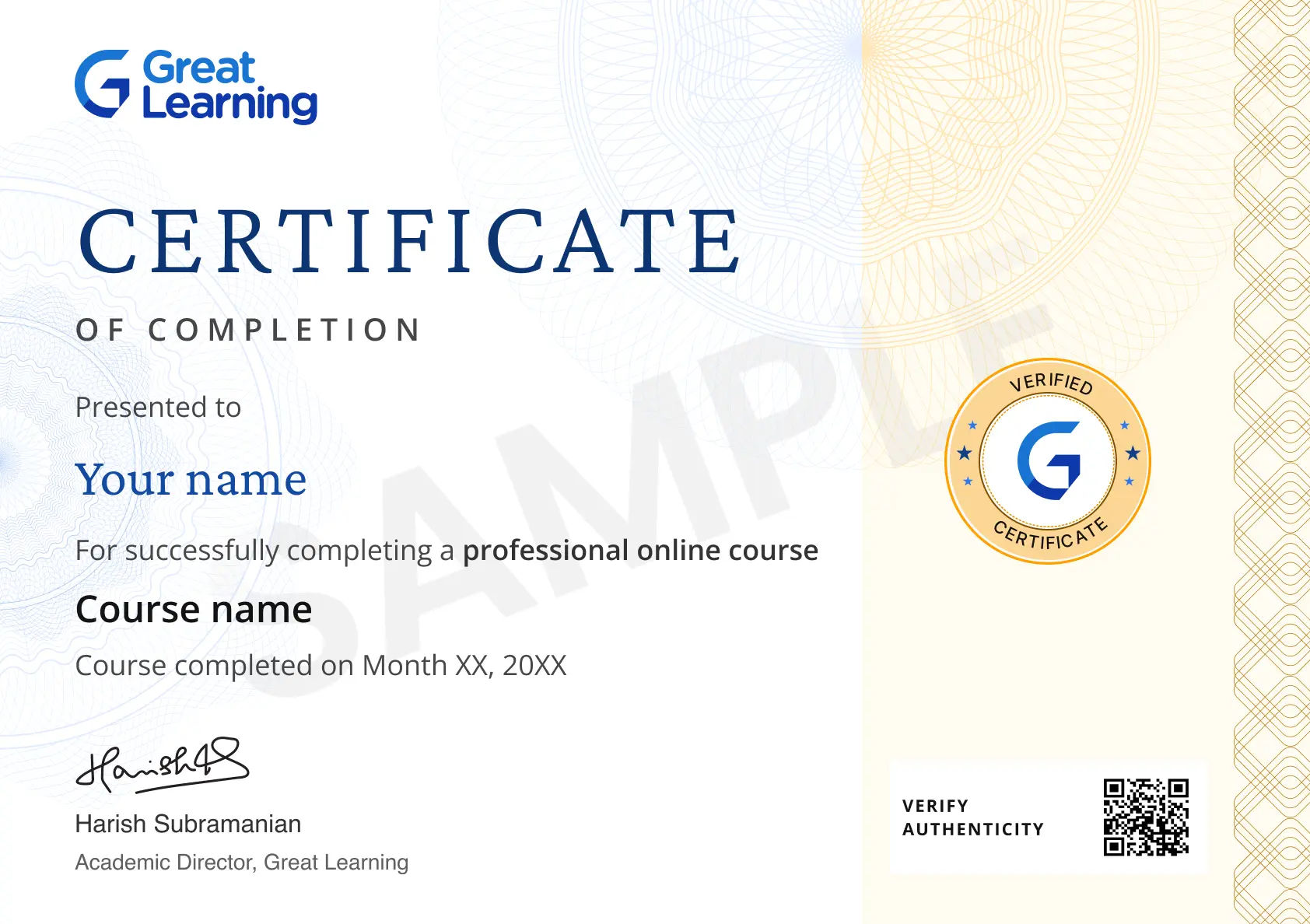
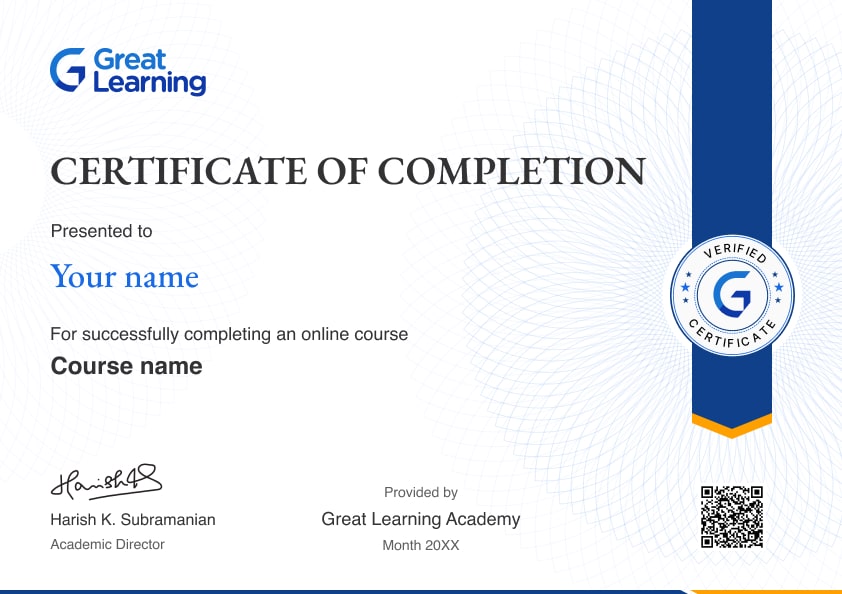
Yes, you will get a certificate of completion for Programming Fundamentals after completing all the modules and cracking the assessment. The assessment tests your knowledge of the subject and badges your skills.
How much does this Programming Fundamentals course cost?
It is an entirely free course from Great Learning Academy. Anyone interested in learning the basics of Programming Fundamentals can get started with this course.
Is there any limit on how many times I can take this free course?
Once you enroll in the Programming Fundamentals course, you have lifetime access to it. So, you can log in anytime and learn it for free online.
Can I sign up for multiple courses from Great Learning Academy at the same time?
Yes, you can enroll in as many courses as you want from Great Learning Academy. There is no limit to the number of courses you can enroll in at once, but since the courses offered by Great Learning Academy are free, we suggest you learn one by one to get the best out of the subject.
Why choose Great Learning Academy for this free Programming Fundamentals course?
Great Learning Academy provides this Programming Fundamentals course for free online. The course is self-paced and helps you understand various topics that fall under the subject with solved problems and demonstrated examples. The course is carefully designed, keeping in mind to cater to both beginners and professionals, and is delivered by subject experts. Great Learning is a global ed-tech platform dedicated to developing competent professionals. Great Learning Academy is an initiative by Great Learning that offers in-demand free online courses to help people advance in their jobs. More than 5 million learners from 140 countries have benefited from Great Learning Academy's free online courses with certificates. It is a one-stop place for all of a learner's goals.
What are the steps to enroll in this Programming Fundamentals course?
Enrolling in any of the Great Learning Academy’s courses is just one step process. Sign-up for the course, you are interested in learning through your E-mail ID and start learning them for free online.
Will I have lifetime access to this free Programming Fundamentals course?
Yes, once you enroll in the course, you will have lifetime access, where you can log in and learn whenever you want to.
Recommended Free Programming courses
-
FREE

-
FREE
-
FREE
-
FREE
-
FREE
-
FREE
 FREE
FREE




Similar courses you might like
-
FREE
-
FREE
-
FREE
-
FREE


Related Interview Preparation Courses

-
McCombs School of Business at The University of Texas at Austin
Post Graduate Program in Cyber Security20 weeks · Online
Know More
Programming Fundamentals Course
Programming is creating instructions that a computer can understand and execute. It involves writing code in a specific programming language, testing it, and debugging any errors that may arise.
The fundamentals of programming include:
Algorithms:
An algorithm is a set of well-defined computer instructions for solving a specific problem or performing a particular task. Algorithms are the building blocks of computerized programming and are used to perform a wide range of tasks, from sorting data to finding the shortest path between two points on a map. Algorithms can be expressed in many ways, including flowcharts, pseudocode, and programming languages. An algorithm design involves analyzing the problem to be solved, identifying the steps required to solve it, and then arranging those steps in the proper order.
Data structures:
A data structure is an approach to organize and store data in a computer program. Different data structures are suited to different tasks and data types, so it is essential to choose the right one for the job. Some common data structures include arrays, linked lists, stacks, queues, trees, and graphs. The choice of data structure can have a crucial impact on the efficiency and performance of a program.
Variables:
Variables store data in a program. A variable has a name and a value, and the value can change during the execution of the program. Variables are used to store inputs from the user, intermediate results of calculations, and final outputs of a program. The data type of a variable controls the type of data it can store, such as integers, strings, or floating-point numbers.
Control structures:
Control structures are statements in a program that controls the flow of execution. They determine the order in which statements are executed and allow for branching and looping. Common control structures include if/else statements, for loops, while loops, and switch statements. These structures allow programs to make decisions, repeat actions, and perform complex operations.
Syntax:
Syntax refers to the rules and conventions for writing code in a particular programming language. It includes rules for naming variables and functions, using punctuation and operators, and indentation. The proper syntax is essential for the readability and maintainability of code and helps prevent errors. Different programming languages have different syntax rules, so it is important to understand the syntax of the language you are using.
Debugging:
Debugging finds and fixes errors in a program. Errors can occur at any stage of development, from syntax errors to logic errors that cause incorrect results. Debugging tools, such as debuggers, can help find errors and understand how a program behaves. Debugging is an important skill for all programmers, and it can involve testing, tracing the execution of code, and reading error messages.
Object-Oriented Programming (OOP):
OOP is a programming paradigm that organizes code into objects representing real-world entities and their properties and behaviors. Objects interact by sending messages, and they can be designed to be reusable and flexible. OOP is a popular software development approach used in many programming languages, including Java, Python, and C++.
Function:
A function is a reusable code block that performs a specific task. Functions can be called from other parts of a program, and they can accept parameters as inputs and return a value as output. Functions allow code to be written in a modular and reusable way, making it easier to maintain and update a program. Functions also help to organize code into smaller, more manageable pieces.
API:
An API, or application programming interface, is a set of functions and procedures allowing the development of applications to access the features or data of an operating system, application, or other services. APIs provide a standardized way for programs to interact with other software.